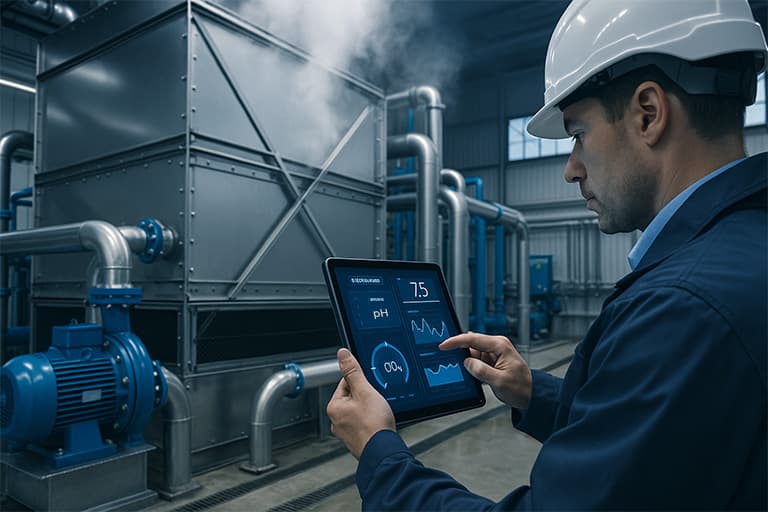
Management of Condensers and Cooling Towers: Use of Chemicals, Reduction of Waste and Health Risks
The correct use of chemicals in cooling towers is essential to ensure efficiency, safety, and sustainability. In this article we will look at how chemical products should be dosed and managed, how to contain waste, and how to reduce related health risks, with a focus on best practices for industrial plants managed by Termoacqua.
Cooling towers operate throu gh water–air heat exchange. However, the circulating water is subject to critical phenomena: scale formation, corrosion, microbial proliferation (e.g. Legionella), and sediment deposits.
Chemical products in the circuit are used to:
- control scaling and fouling (with antiscalants, dispersants);
- inhibit corrosion (with passivating additives, metal inhibitors);
- maintain chemical balance (pH, alkalinity, hardness);
- act as biocides (or auxiliaries) to contain bacterial and algal colonies.
Well-calibrated chemistry extends the life of the plant, improves performance, and reduces operating costs.
Optimizing chemical dosing is essential to minimize waste and environmental impact. Here are some practical strategies:
- Automatic blowdown with conductivity probe: allows targeted discharge of high-salinity water, reducing excessive chemical use.
- Real-time monitoring (sensors, automation): continuous control of pH, conductivity, and temperature enables precise interventions and avoids overdosing.
- Use of longer-lasting formulations or intelligent dosing: new products with controlled release or multifunction blends (antiscalant + inhibitor) reduce the total quantity required.
- Water saving through technologies such as reverse osmosis systems and pH control.
By adopting these strategies, Termoacqua can deliver plants with lower operating costs and reduced environmental impact.
Termoacqua applies the provisions of the ATS Brescia Guidelines for the prevention of Legionella in cooling towers.
One of the main risk factors in cooling towers is the proliferation of microorganisms, such as Legionella. Towers act as a source of aerosols that can carry bacteria into the environment.
To mitigate the risk, it is necessary to:
- apply effective biocidal treatments (e.g. chlorine, hydrogen peroxide, CIT/MIT) with controlled residuals;
- carry out periodic disinfections (thermal or chemical shock) at scheduled times (start/end of cycle, periods of inactivity);
- clean and drain circuits, including maintenance of drift eliminators and prevention of water stagnation;
- carry out Legionella risk assessments and adapt management practices in accordance with local regulations (Ministry of Health Guidelines).
With its experience in water treatment, Termoacqua can support clients in drafting risk management plans, with periodic audits and qualified technical assistance.
To align with real operational needs, Termoacqua applies the following best practices in its systems:
- network design with easy accessibility for maintenance, sampling, and inspection points;
- installation of automatic blowdown systems and modular dosing units;
- use of customized chemical blends based on local water quality (hardness, alkalinity, salinity);
- tracking and recording of operating data (pH, conductivity, biocide residuals) for control and auditing;
- training and customer support for daily operations (monitoring, minimal interventions).
With these integrated solutions, Termoacqua customers obtain safer, more reliable systems with controlled costs.
The benefits derived from optimal chemical management in cooling towers include:
- longer service life of system components and fewer failures;
- reduced chemical consumption and operating costs;
- improved heat exchange efficiency;
- lower health risks and regulatory compliance;
- competitive advantage in the services offered, thanks to the ability to deliver a “turnkey” service with high-value technical support.