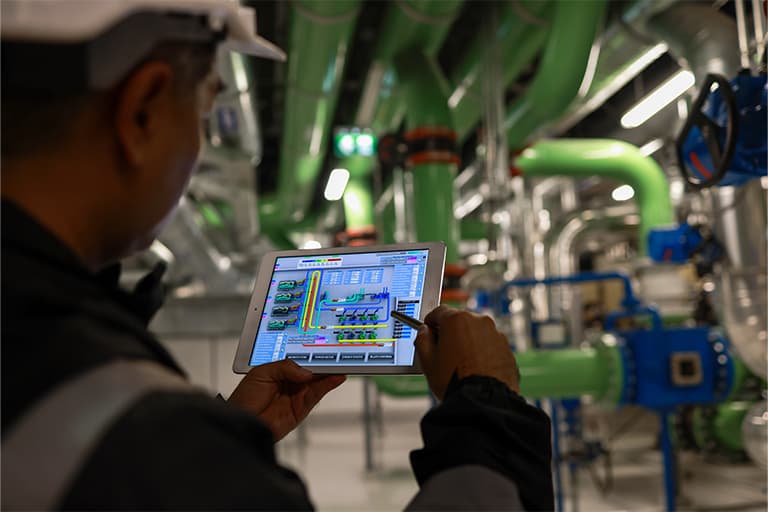
Digital Water Monitoring: How Automation Improves Safety and Efficiency
Water is a dynamic resource, constantly in motion and transformation.
Ensuring its quality today requires more than just treatment: it must be monitored, analyzed, and managed in real time. Automation in water treatment represents one of the most significant advancements of recent years, combining safety, efficiency, and sustainability.
Termoacqua has made digital control a cornerstone of its engineering approach, developing systems that supervise every operational parameter, reduce waste, and prevent anomalies before they become emergencies.
Traditionally, water monitoring relied on periodic analyses and manual checks.
Today, thanks to digitalization and the Internet of Things (IoT), it is possible to collect and manage thousands of data points in real time, turning them into automatic operational decisions.
Termoacqua automation systems integrate sensors, probes, and intelligent controllers to continuously measure parameters such as:
- pH and conductivity
- Temperature and pressure
- Flow rates and tank levels
- Concentrations of chemicals and disinfectant residuals
- Presence of suspended solids or turbidity
These data are transmitted to remote control platforms, allowing 24/7 plant supervision and automatic adjustment of treatment cycles.
Integrating digital systems is not just a technological choice—it is an investment that delivers economic efficiency and operational safety.
- Real-time control
Every parameter is recorded and analyzed instantly, enabling intervention before an anomaly causes damage or plant downtime.
Automation maintains water quality within constant limits, even under variable conditions. - Energy and water savings
Smart systems automatically regulate pressures, flows, and chemical dosing, avoiding overdosing or unnecessary cleaning cycles.
Result: lower energy and chemical consumption and up to 30% reduction in operating costs. - Microbiological safety
Digital control ensures disinfectant systems (e.g., hypochlorous acid or chlorine dioxide) maintain optimal concentrations, preventing Legionella growth and biofilm formation. - Traceability and regulatory compliance
All data are recorded and stored, creating a digital operational log useful for audits, inspections, and environmental or health certifications.
Essential for healthcare facilities, food industries, and plants subject to strict regulations.
Every Termoacqua plant operates as an intelligent ecosystem, where sensors and control logic work in synergy. Key technologies include:
- Industrial PLCs programmed for automatic management of cleaning, flushing, and dosing cycles
- Inverters and electronic control modules for pumps and valves, adapting flow to actual demand
- Remote monitoring via network or cloud, enabling plant control from any device
- Graphic dashboards and automated alerts, notifying Termoacqua technicians and the client of anomalies
- Data logging and predictive analysis to optimize maintenance and extend component life
This makes the plant autonomous and responsive, capable of self-calibration and high efficiency even without constant staff presence.
One of the main advantages of digitalization is the shift from reactive to predictive maintenance.
Continuous data collection allows Termoacqua algorithms to detect anomalous variations in parameters (pressure, conductivity, flow) and anticipate potential failures or inefficiencies.
Benefits include:
- Reduced downtime and maintenance costs
- Planning filter or membrane replacements only when truly necessary
- Extended operational life of equipment
- Ensured continuity of service even in complex or remote facilities
- Digitalizing a water treatment plant also makes it more sustainable. Automation optimizes:
- Energy usage, avoiding consumption peaks
- Chemical dosing
- Reuse of wash water
In this way, every Termoacqua plant actively contributes to the client’s ESG goals (Environmental, Social, Governance), reducing environmental impact and improving natural resource management.
Termoacqua does not provide mere equipment, but integrated treatment and control systems.
Every project is managed from initial analysis to commissioning, including:
- Customized sensor and PLC configuration
- Web-accessible monitoring dashboards
- Remote and on-site technical support
- Dedicated training for client technicians
This multidisciplinary approach ensures operational continuity, savings, and safety, hallmarks of a modern water treatment plant.
Digital monitoring and automation are no longer optional—they are essential for intelligent water management.
Termoacqua combines engineering, chemistry, and electronic control to create plants that are efficient, safe, and sustainable.
Because the future of water treatment is driven by data, and only those who can interpret it can truly transform water into value.