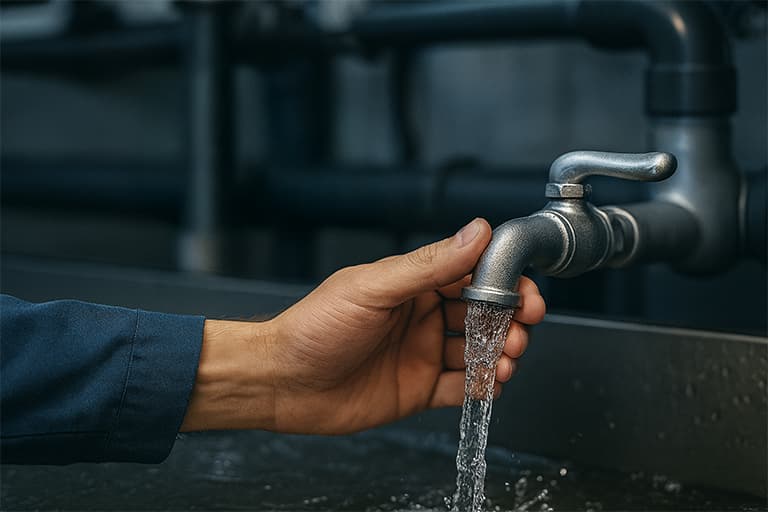
Water Footprint: How Water Treatment Makes It Possible to Reduce It in Industrial and Civil Sectors
Every production process, every service, and every daily action leaves an invisible but measurable mark: the water footprint.
This parameter, increasingly used internationally, indicates the total amount of freshwater used to produce a good or service throughout its entire life cycle.
In an era marked by drought, rising energy costs, and a strong focus on sustainability, reducing the water footprint has become a strategic objective for companies, public authorities, and citizens.
But how can an effective reduction be achieved in practice?
The answer lies in water treatment: technology, monitoring, and a culture of responsible management. These are the three pillars on which Termoacqua has based its commitment for years.
The water footprint of a process is not limited to direct water consumption: it also includes the water used in industrial processes, transportation, energy production, and raw materials.
It is divided into three components:
- Blue water footprint: water withdrawn from aquifers, rivers, or water supply networks;
- Green water footprint: rainwater incorporated into biological processes (e.g. agriculture);
- Grey water footprint: the amount of water required to dilute pollutants produced until acceptable environmental standards are reached.
Reducing this footprint means acting on all fronts: minimizing withdrawals, optimizing reuse, and lowering contaminant concentrations.
This is where water treatment comes into play — not as a simple technical service, but as an integrated sustainability strategy.
Every liter of water recovered, regenerated, or saved in a system represents a step forward in sustainability. Termoacqua addresses the issue systemically, acting in three key areas:
1. Process Efficiency and Optimization
Through filtration, softening, and reverse osmosis systems, it is possible to reduce blowdown volumes, recycle part of the flows, and ensure more stable process water.
“Cleaner” water means less need for replacement and lower overall consumption.
In the civil sector, for example, filtration and proper management of sanitary water reduce waste and extend the life of systems and equipment.
2. Recovery and Reuse
The treatment plants designed by Termoacqua allow wastewater to be reused to feed cooling towers, industrial circuits, or irrigation systems.
Through targeted polishing treatments, wastewater can become a resource again, not a waste.
3. Control and Automation
Digitalization is a fundamental ally in reducing the water footprint.
The monitoring systems installed by Termoacqua allow real-time measurement of water and chemical parameters, quickly identifying anomalies and optimizing washing, blowdown, and dosing cycles.
The result is more precise, predictable, and sustainable consumption.
The most significant applications are found in the manufacturing, food, and pharmaceutical sectors, where water is both a raw material and an energy carrier.
Some typical cases include:
- Mechanical and automotive industries: recycling systems for washing baths and cooling water;
- Food sector: controlled reuse of process water, with in-line automatic disinfection and low-consumption reverse osmosis systems;
- Chemical-pharmaceutical sector: continuous treatment systems to ensure constant purity and minimize liquid waste.
In all these contexts, Termoacqua integrates components, automation, and dedicated chemical formulations, adapting technology to local water characteristics and required purity levels.
Water treatment also plays a decisive role in the civil and public sectors.
Systems for reusing greywater (from sinks, showers, washing machines) and harvesting rainwater represent concrete solutions to reduce withdrawals from the network and optimize water resources.
In residential buildings or multi-storey complexes, the combination of filtration, softening, and automatic disinfection systems enables water savings of up to 30%.
With its experience in civil and condominium applications, Termoacqua offers systems designed to integrate easily with existing networks and guarantee maximum sanitary safety.
For companies most attentive to sustainability, reducing the water footprint is not only a technical advantage but also a communicative value.
It is in fact among the ESG indicators (Environmental, Social, Governance) used to measure companies’ environmental impact.
Termoacqua also supports its clients in this area by providing:
- certifiable and traceable consumption data;
- consultancy on water measurement and reporting;
- monitoring systems integrable into sustainability reports.
Reducing the water footprint therefore means increasing competitiveness, improving reputation, and gaining easier access to calls and funding aimed at the ecological transition.
Water is a common good, but responsibility for its management belongs to everyone: companies, institutions, and citizens.
With its systems and services, Termoacqua promotes a more efficient and circular water economy model, in which every liter saved represents a step toward a more balanced future.
The water footprint is not just a number, but a way to measure awareness.
And reducing it — through technological intelligence, training, and collaboration — is the best way to give value back to water and to the planet.