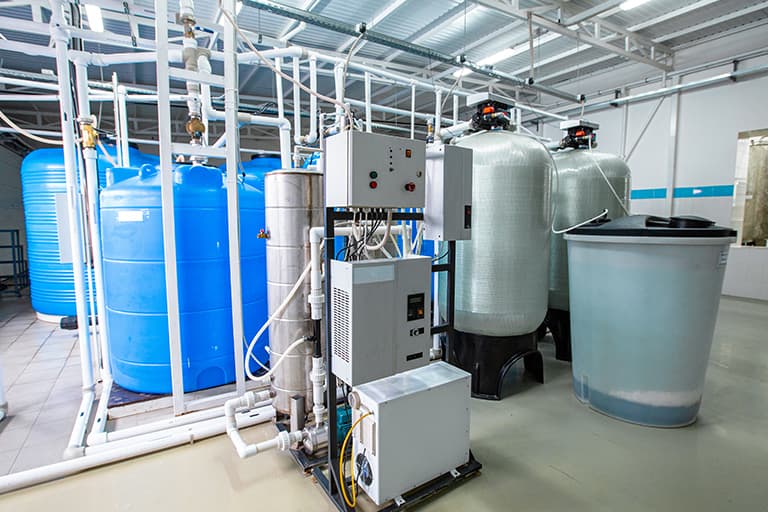
Reverse Osmosis: Industrial Applications and Operating Principles
Water is a precious yet complex resource, containing salts, impurities, organic compounds, and contaminants that can compromise its use in industrial processes or civil systems. Among the most effective technologies to obtain pure, controlled water, reverse osmosis (RO) has long held a central role.
Termoacqua designs and builds custom RO plants, integrating engineering, automation, and continuous quality control for industrial, civil, and healthcare applications.
Natural osmosis is a spontaneous process: water moves from a solution with low solute concentration to a solution with higher concentration through a semipermeable membrane, seeking equilibrium.
Reverse osmosis inverts this process by applying pressure exceeding the osmotic pressure, forcing water through a membrane that retains dissolved substances, allowing only pure water molecules to pass.
This results in two separate flows:
- Permeate: purified water, free of salts and contaminants;
- Concentrate: residual stream containing impurities.
RO membranes have pores smaller than 0.001 microns, capable of blocking salts, metals, bacteria, pesticides, PFAS, and microplastics.
- Pre-treatment
Water is filtered and softened to remove suspended solids, free chlorine, and hardness, preventing membrane scaling. Common methods include sand filters, activated carbon, and sediment cartridges. - High-pressure section
Multistage pumps drive water through the membranes at pressures ranging from 8 to 70 bar, depending on salinity and intended use (freshwater or seawater). - Membrane modules
Spiral-wound or hollow-fiber membranes separate permeate and concentrate. Termoacqua uses certified modules with high permeation rates and long operational life. - Post-treatment and monitoring
Permeate can undergo additional polishing, mineralization, or UV disinfection. Sensors and PLCs continuously monitor conductivity, flow, and pressure to maintain optimal parameters.
Modern RO technology overcomes past limitations. High-permeability membranes and energy recovery systems reduce water and energy consumption by up to 40%.
Termoacqua plants integrate:
- Proportional valves and digital sensors for automated flow optimization;
- Energy recovery modules that reuse concentrate pressure;
- Remote monitoring for real-time performance analysis and preventive interventions.
These innovations reduce operating costs, extend component life, and ensure consistent water quality.
Food & Beverage
Purified water free of odors and unwanted tastes, essential for product quality, steam generation, rinsing, and dilutions.
Pharmaceutical & Cosmetic
Ultrapure water compliant with European pharmacopeias, with integrated automatic disinfection to remove ions and microorganisms.
Mechanical & Electroplating
Demineralized water for cooling circuits, precision washing, and electroplating baths.
Civil & Municipal
RO plants enhance water quality in aqueducts, healthcare facilities, and residential complexes, reducing dissolved solids.
Maintaining high RO performance requires scheduled maintenance and continuous monitoring:
- CIP (Cleaning In Place) for membranes;
- Sensor verification and calibration;
- Monitoring of flow, pressure, permeate yield, and salt rejection;
- Scheduled prefilter replacement and automatic sanitization.
Remote monitoring enables historical trend analysis and preventive interventions, avoiding downtime and water waste.
- Consistent water quality tailored to client needs;
- Operational cost reduction through energy savings and automation;
- Environmental sustainability via reduced chemical use and permeate reuse;
- Safety and traceability via digital control and periodic analysis.
Each RO plant is customized based on local water characteristics, production requirements, and regulatory standards.
Reverse osmosis is a key technology for water sector sustainability. It reduces consumption, improves water quality, and enables resource recovery in circular processes.
Combined with disinfection and recovery systems, Termoacqua RO plants can reuse up to 70% of process water, significantly cutting waste and environmental costs.