Microplastics: Current Research and Available Filtration Technologies
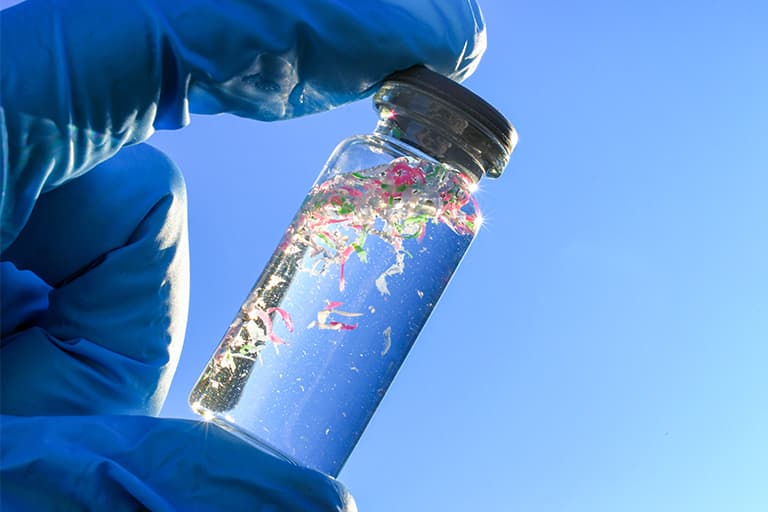
Tiny, almost invisible, yet everywhere: microplastics are among the most pervasive and challenging forms of pollution today. These fragments, smaller than 5 millimeters, accumulate in seas, rivers, groundwater, and even drinking water.
Scientific research has demonstrated that microplastics can enter the food chain, disrupt ecosystems, and even reach the human body. Addressing this issue requires technologies capable of capturing microscopic particles and ensuring truly pure water. Among the most effective solutions are advanced filtration and reverse osmosis (RO), areas in which Termoacqua has developed high-performance systems suitable for both civil and industrial applications.
Microplastics fall into two main categories:
- Primary microplastics: intentionally produced in micro form (e.g., cosmetic microbeads, industrial abrasives, 3D printing resins).
- Secondary microplastics: generated by the degradation of larger plastics (bottles, synthetic textiles, tires, paints).
These fragments are released during laundry, waste degradation, or everyday plastic use. Once in the environment, they are transported by watercourses into water bodies, where they can persist for decades.
Recent research has found microplastics even in treated drinking water and in purified wastewater, highlighting that conventional filtration systems are not always sufficient.
In recent years, studies by the European Chemical Agency (ECHA) and the World Health Organization (WHO) have recognized microplastics as potential carriers of chemical and microbiological contaminants. They can absorb heavy metals and organic compounds and act as “sponges” for bacteria and biocides, potentially altering biological balances.
Although there are no definitive regulatory limits at the European level yet, EU Directive 2020/2184 on water quality for human consumption requires monitoring of microplastic particles, with parameters expected to be updated in the coming years.
This scenario encourages companies and water managers to adopt removal technologies today, in anticipation of future environmental standards.
Fine Mechanical Filtration
- Cartridge or modified sand systems with filtration thresholds of 1–5 microns can retain larger microplastics.
- Often used as pre-filters to protect more advanced downstream stages.
Ultrafiltration (UF)
- Uses membranes with pores in the 0.01–0.1 micron range, effectively blocking sub-micron particles, bacteria, and colloids.
- Can be integrated upstream of RO to reduce membrane load.
Nanofiltration (NF) and Reverse Osmosis (RO)
- RO is the most effective barrier against microplastics:
- RO membranes have pores as small as 0.0001 micron, capable of removing over 99.9% of plastic particles, along with salts, pesticides, and PFAS.
- Termoacqua systems combine multiple filtration and RO stages to ensure maximum purity and stable physicochemical parameters, tailored to source water quality and customer needs.
Adsorption Filtration
- Advanced adsorbent materials (e.g., modified activated carbon or zeolites) can retain plastic particles and associated organic compounds.
- Effective for civil plants or surface waters rich in micropollutants.
Termoacqua has developed a range of customized plants and modules combining physical filtration and RO in compact, automated configurations:
- Dual-stage RO/UF plants to remove microplastics, PFAS, and organic residues;
- Automatic backwash systems to maintain performance over time and reduce water waste;
- Digital monitoring of turbidity and conductivity to verify removal efficiency in real-time;
- Modular versions for industrial and civil plants, with optimized energy consumption using inverters and pressure recovery.
The dual objective is to ensure safe water compliant with emerging regulations while minimizing the environmental impact of the treatment process.
Combating microplastics is not only a technical challenge but also a cultural one. Reducing single-use plastics, promoting recycling, and intelligently managing wastewater are integral to this path.
Termoacqua participates in research and environmental monitoring projects in collaboration with Italian institutions and universities, contributing to the development of new filtration materials and predictive algorithms for particle detection.
Every technical intervention becomes part of a broader commitment: restoring water to its original purity and building a future in which technology and nature coexist in balance.