How Reverse Osmosis Works: A Technical Guide to Water Treatment
Reverse osmosis is one of the most widely used technologies in technical water treatment when it is necessary to obtain water that is purer, more stable, and with a reduced concentration of dissolved salts.
It finds applications both in improving mains water and in industrial and hospital settings, where water quality directly impacts the proper functioning of equipment and process continuity.
To understand how reverse osmosis works, however, it is helpful to start with the natural principle of osmosis and see how this process is "reversed".
Osmosis is a natural phenomenon fundamental to plant and animal life. It is the process that allows cells to regulate the passage of water through their membrane, maintaining the internal balance necessary for their functioning.
The cellular membrane is semipermeable: it allows water to pass through but retains certain dissolved substances, such as salts, sugars, and proteins.
From a chemical-physical standpoint, osmosis occurs when two aqueous solutions with different salt concentrations are separated by a semipermeable membrane. Under this condition, water naturally tends to move from the more dilute solution toward the more concentrated one until an equilibrium between the two concentrations is reached.
This movement generates a force called osmotic pressure. The term comes from the Greek "osmós", which means push, precisely describing the tendency of water to move through the membrane. The greater the difference between the salt concentrations of the two solutions, the higher the osmotic pressure generated.
Reverse osmosis starts from this very same principle but applies it in the opposite direction. By exerting a pressure higher than the natural osmotic pressure, water is forced to cross the semipermeable membrane in the reverse direction.
This produces two distinct flows: on one side, a highly diluted water, low in salts and dissolved substances; on the other, a more concentrated solution that collects the elements retained by the membrane.
The required pressures vary based on the type of water being treated. Seawater may require very high pressures, equal to several dozen atmospheres, while for mains water or weakly brackish water, the required values are generally lower and can hover around 10 bar.
Modern technologies have made reverse osmosis systems compact, efficient, and adaptable to highly diverse contexts. They can be used to treat water with high salt concentrations, to improve the quality of common mains water, or to produce demineralized water for technical purposes.
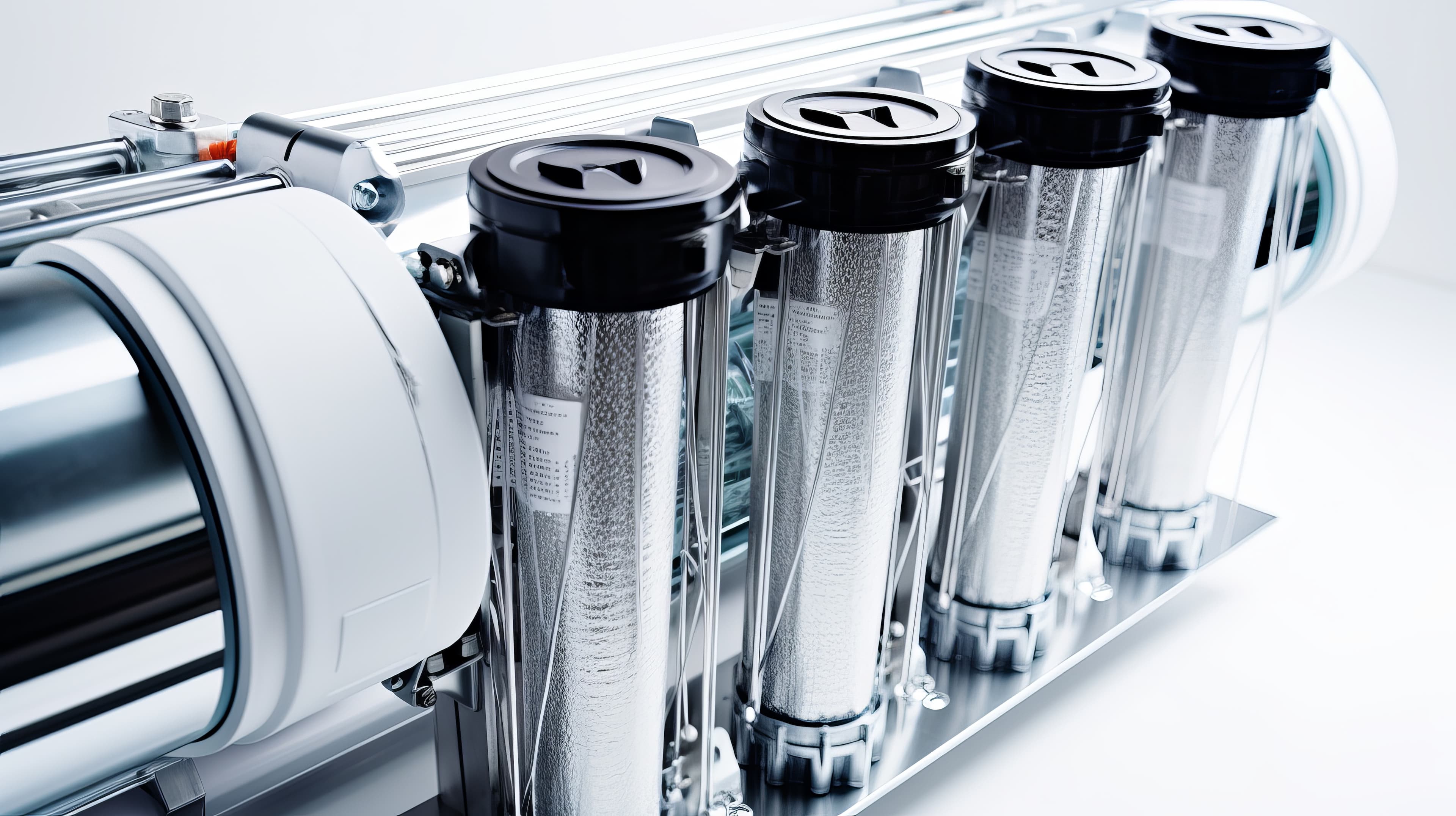
A reverse osmosis system comprises a few main components, primarily the osmotic membrane and the high-pressure pump.
- The osmotic membrane consists of a central core around which a semipermeable sheet made of synthetic material, such as polysulfone or other technical materials, is spirally wound. This structure allows for a high contact surface area within a relatively compact space, improving treatment efficiency. Membranes are classified based on size and production capacity. Sizes are often indicated in inches: for example, a 4040 membrane corresponds to a module 40 inches long and 4 inches wide. Production capacity, on the other hand, can be expressed in GPD (gallons per day) or as hourly flow rate in industrial systems.
- High-pressure pumps come into play to guarantee the pressure necessary to reverse the natural osmotic pressure (usually ranging between 10 and 70 bar, depending on the water's salinity).
An industrial reverse osmosis system also includes other elements, such as:
- The pre-filtration system, which retains particles and impurities that could damage the membranes.
- Pressure gauges (manometers), which allow monitoring of operating pressures.
- Flow meters (flowmeters), which measure permeate and concentrate.
- The conductivity meter, which monitors treated water quality by checking the conductivity of the permeate.
- The control panel, which manages the automation, protection, and control of the system.
The operation of a reverse osmosis system requires the water to be treated to be pushed toward the membrane by a pump. As the water passes through the membrane, two flows are separated: the permeate and the concentrate.
- The permeate is the treated water, low in salts and intended for use.
- The concentrate, conversely, is the flow containing a higher concentration of salts and substances retained by the membrane, which is normally discarded or managed according to the system's configuration.
The fundamental parameters for evaluating the performance of a reverse osmosis system include the salt content of the permeate, the system yield, and the membrane rejection.
The salt content of the permeate is often referred to as fixed residual or TDS, an acronym for Total Dissolved Solids. It is measured in mg/L or ppm and represents the total amount of dissolved solids present in the water. A low TDS means water that is lower in salts and more suitable for technical applications requiring controlled parameters.
The system yield—meaning the amount of permeate relative to the total amount of inlet water—can vary based on configuration. An osmotic membrane can produce an average permeate share of about 20% of the inlet flow in simpler systems, whereas in larger systems with multiple membranes in series and configurations designed to optimize recovery, this value can exceed 75%.
The membrane rejection represents the capacity to retain solutes present in the water. This value depends on several factors: inlet water characteristics, operating pressure, temperature, membrane quality, pre-treatment, and system maintenance. Under proper conditions, removal values for many substances present in the water can exceed 95%.
In industrial systems, pre-treatment plays a fundamental role in keeping the performance of the reverse osmosis system efficient and consistent. Before reaching the membrane, the water may contain suspended solids, chlorine, high hardness, iron, manganese, organic substances, or particles that risk clogging, scaling, or damaging the membrane, negatively affecting TDS, yield, and rejection capacity.
For this reason, depending on the inlet water quality, sediment filters, active carbon filters, water softeners, antiscalant dosing, or other filtration systems may be provided upstream of the reverse osmosis system.
Termoacqua features a complete range of reverse osmosis plants and filtration systems designed to meet various flow rate and application needs. This variety allows the treatment to be configured based on water characteristics and required goals, maintaining a technical approach consistent with the context of use.