Emerging Contaminants: Pharmaceuticals, Cosmetics, and Pesticides in Water
For decades, we took it for granted that traditional water treatment was sufficient to guarantee purity.
Today, however, we know this is no longer true.
Pharmaceuticals, hormones, microplastics, cosmetics, and pesticides — all grouped under the category of “emerging contaminants” — are redefining the boundaries of water management.
These substances, often present in infinitesimal concentrations, escape conventional treatment systems and end up accumulating in aquatic ecosystems, sometimes entering the food chain.
Understanding how to manage them is both an environmental and technological challenge, requiring new skills and integrated solutions — the field in which Termoacqua works every day.
The term emerging contaminants refers to those chemical or biological substances that are not yet specifically regulated, but which scientific research has identified as potentially dangerous for the environment or human health.
Among the most common are:
- Pharmaceutical residues (antibiotics, analgesics, hormones, antidepressants);
- Cosmetic and detergent compounds (parabens, silicones, microplastics);
- Pesticides and biocides used in agriculture and urban maintenance;
- Perfluorinated compounds (PFAS) and industrial solvents;
- Nanomaterials and microplastics deriving from production processes or degradation of synthetic materials.
Their danger derives not only from direct toxicity, but also from persistence and bioaccumulation: once released into the environment, they can remain active for years, interacting with other compounds and amplifying long-term effects.
- Emerging contaminants enter the water cycle in various ways:
- through civil and hospital discharges (pharmaceuticals and cosmetics);
- from agricultural activities (crop protection products, fertilizers);
- from industrial effluents or production processes releasing solvents, oils, or microplastics;
- even from atmospheric release of volatile compounds that return to the ground with rainfall.
Many of these substances are difficult to biodegrade and are not retained by conventional treatment plant filters. For this reason, even minimal but constant quantities can have significant effects on flora, fauna, and public health.
Conventional treatment systems (sedimentation, biological oxidation, filtration) are designed to remove “known” contaminants: suspended solids, organic compounds, nitrogen, phosphorus. But they are not always effective against complex molecules such as antibiotics or hormones, which resist biological processes and pass through treated effluents unchanged.
Managing emerging contaminants requires advanced and combined approaches, integrating next-generation physical, chemical, and biological technologies. This is where Termoacqua’s expertise comes into play.
Termoacqua integrates several solutions into its plants dedicated to the removal and containment of emerging contaminants, in line with the most recent European and scientific guidelines:
- Advanced Oxidation Processes (AOP)
Through the use of oxidizing radicals, AOPs degrade complex molecules, transforming them into harmless compounds. Processes such as ozonation, UV photocatalysis, and advanced peroxidation are increasingly applied in the treatment of industrial and hospital effluents. - Membrane Filtration (UF, NF, RO)
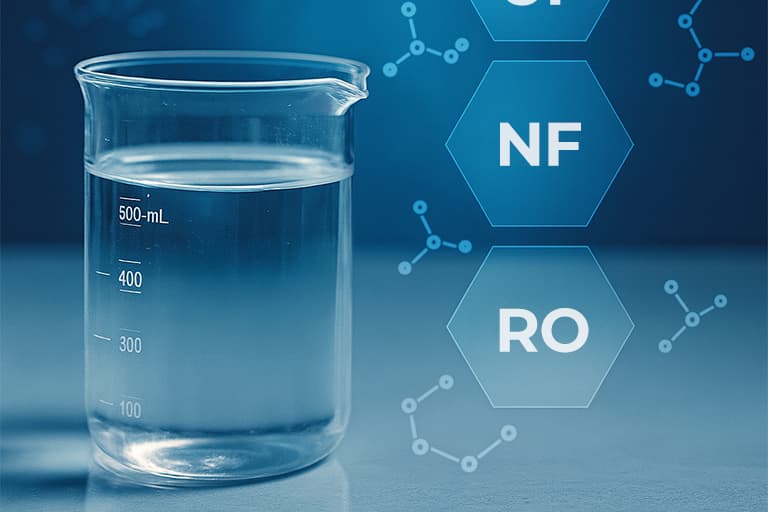
Ultrafiltration (UF), nanofiltration (NF), and reverse osmosis (RO) allow physical removal of micro-pollutants and microplastics, ensuring high water purity. Termoacqua designs modular systems integrable into existing processes, with automated cleaning cycles and continuous monitoring. - Adsorption on Activated Carbon and Special Resins
The use of powdered or fixed-bed activated carbon makes it possible to retain residues of pesticides, solvents, and persistent aromatic compounds. In the most critical cases, adsorption is combined with thermal or biological regeneration systems. - Advanced Disinfection and Hypochlorous Acid
For the final stage, Termoacqua employs in situ disinfection technologies based on hypochlorous acid — an ecological, effective solution compatible with technical or civil water uses.
Hypochlorous acid enables odorless and tasteless dosing and does not cause acidic aggression to the systems into which it is introduced, unlike what is often experienced with conventional disinfectants. This treatment eliminates microbiological residues without producing toxic by-products.
Managing emerging contaminants also means preventing their formation and spread.
Termoacqua promotes an integrated approach that combines technology and culture:
- continuous monitoring of chemical and biological parameters with dedicated probes;
- training of technical staff and clients on the conscious use of chemical products and detergents;
- upstream control of production processes to reduce the introduction of unwanted substances.
Only by knowing and measuring what is discharged can effective action be taken.
The challenge of emerging contaminants cannot be won with a single plant, but with a network of responsibility.
Industries, public operators, and citizens must collaborate to reduce the release of critical substances, improve treatment, and raise awareness about the correct use of everyday products.
With its multidisciplinary expertise, Termoacqua acts as a technical and scientific partner, providing support in the design of tailor-made solutions, regulatory consultancy, and environmental monitoring.
The European Union is introducing increasingly stringent limits for emerging micro-pollutants.
Ahead of these directives, Termoacqua collaborates with research bodies and specialized laboratories to test new filtering materials, photocatalytic reactors, and integrated automation systems.
The goal is clear: to make safer and cleaner water possible in every context, even in the face of future chemical challenges.
Emerging contaminants remind us that water purity is not guaranteed forever: it must be protected with intelligence, innovation, and responsibility. Termoacqua translates this awareness into action, offering plants, products, and services that help companies and communities reduce the invisible impact of these substances.
Because true innovation is not only technological, but cultural: learning to look at water with respect and to treat it for what it is — a vital resource, not an inexhaustible one.